

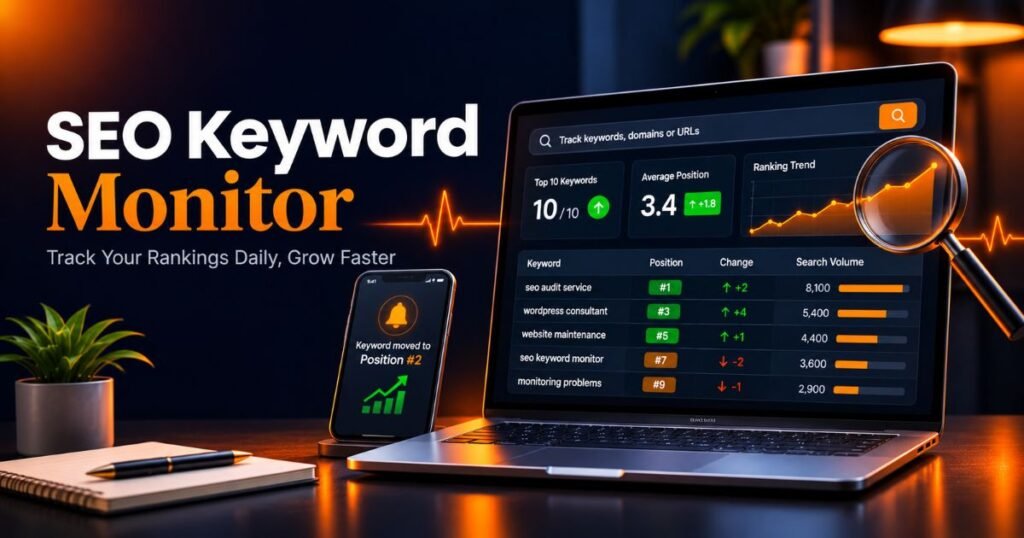
A client doesn’t call when rankings are steady. They call when a keyword that used to sit at position 3 quietly slides to position 14, and nobody noticed for three weeks. That’s the real argument for seo keyword monitor tools — not vanity tracking, but catching the drop before the client’s own search does.
A one-time audit tells you where you stand today. Keyword monitoring tells you the moment that changes.
Why Keyword Monitoring Matters More Than a One-Time Audit
Search results move constantly — algorithm updates, competitor content pushes, SERP feature changes, even seasonal demand shifts. An audit is a snapshot; monitoring is the trend line. Without ongoing tracking, you only find out about a ranking drop when traffic or leads have already fallen, which is usually two to four weeks after the actual cause.
- Google rolls out core updates several times a year, often with no advance notice
- Competitors publish or update content that can displace your rankings overnight
- Technical issues (a bad deploy, a broken redirect, a noindex tag left on) can tank a page without any content change
- Clients ask “how are we doing” far more often than they ask for a full audit
What a Good SEO Keyword Monitor Actually Tracks
Not every tracked keyword deserves the same attention. A useful monitoring setup focuses on:
- Keyword rankings for the 10-20 terms tied directly to revenue, checked daily or weekly rather than monthly
- Keyword difficulty shifts — a term that was KD 20 last quarter can become KD 45 as competition increases
- SERP feature changes (losing a featured snippet or People Also Ask placement is a ranking change even if the position number doesn’t move)
- New competitors entering the top 10 for your tracked terms
- Search volume trends, so you know if a drop is a real loss or just seasonal demand cooling off
Common Keyword Monitoring Mistakes Agencies Make
Tracking everything is almost as unhelpful as tracking nothing:
- Monitoring 500 keywords when only 20 drive actual business — the signal gets buried in noise
- Checking ranks monthly, which means a two-week ranking drop looks identical to a one-day blip by the time anyone looks
- Reporting raw position numbers without context on volume or difficulty, so a move from #8 to #11 gets flagged as urgent when it’s barely noticeable in real traffic
- Treating seo audits and ongoing monitoring as the same task, when they answer different questions
Keyword Monitoring vs. Keyword Research — They’re Not the Same Thing
Keyword research finds new opportunities: terms you don’t rank for yet, gaps competitors have missed, topics worth building content around. On the other hand, keyword monitoring watches the terms you already rank for and flags when something changes. Agencies that only do research (a report once a quarter) miss the drops that happen in between. The two should run side by side, not as a substitute for each other.
How Often Should You Check Keyword Rankings?
For the handful of terms that matter most, daily or every-other-day tracking catches a drop while it’s still small enough to investigate calmly. For the long tail of secondary keywords, weekly is usually enough. What matters isn’t the exact frequency — it’s that the check happens automatically and surfaces a change, rather than relying on someone remembering to log in and look.
Frequently Asked Questions
How many keywords should I actually monitor closely?
Start with the 10-20 terms that map directly to revenue or lead volume. Everything else can be checked less frequently without much real risk.
What causes a sudden ranking drop that isn’t a Google update?
Technical issues are the usual suspects: a broken internal link, a page accidentally set to noindex, a slow server response after a migration, or lost backlinks from a site that took down the page linking to you.
Is keyword monitoring only useful for large sites?
No — smaller sites often feel the impact of a ranking drop faster, since they typically rely on a smaller set of keywords for most of their traffic. Losing one of those terms is a bigger relative hit than it would be for a site ranking for thousands of phrases.
A monitoring setup is only as useful as what it does with the data. PulseWMS tracks keyword rankings alongside uptime and technical SEO health in one dashboard, so a drop shows up next to the technical change that likely caused it. For a deeper look at tracking methodology, Semrush’s guide to position tracking is a solid companion read.
Keyword research finds new opportunities: terms you don’t rank for yet, gaps competitors have missed, topics worth building content around. Keyword monitoring watches the terms you already rank for and flags when something changes. Agencies that only do research (a report once a quarter) miss the drops that happen in between. The two should run side by side, not as a substitute for each other.
How Often Should You Check Keyword Rankings?
For the handful of terms that matter most, daily or every-other-day tracking catches a drop while it’s still small enough to investigate calmly. For the long tail of secondary keywords, weekly is usually enough. What matters isn’t the exact frequency — it’s that the check happens automatically and surfaces a change, rather than relying on someone remembering to log in and look.
Frequently Asked Questions
How many keywords should I actually monitor closely?
Start with the 10-20 terms that map directly to revenue or lead volume. Everything else can be checked less frequently without much real risk.
What causes a sudden ranking drop that isn’t a Google update?
Technical issues are the usual suspects: a broken internal link, a page accidentally set to noindex, a slow server response after a migration, or lost backlinks from a site that took down the page linking to you.
Is keyword monitoring only useful for large sites?
No — smaller sites often feel the impact of a ranking drop faster, since they typically rely on a smaller set of keywords for most of their traffic. Losing one of those terms is a bigger relative hit than it would be for a site ranking for thousands of phrases.
A monitoring setup is only as useful as what it does with the data. PulseWMS tracks keyword rankings alongside uptime and technical SEO health in one dashboard, so a drop shows up next to the technical change that likely caused it. For a deeper look at tracking methodology, Semrush’s guide to position tracking is a solid companion read.