

Generative Engine Optimization (GEO) audits help agencies review whether a client website is clear, trustworthy, technically accessible, and useful enough to be understood and cited in AI-driven search experiences. A GEO audit should not be treated as a separate trend exercise. It should connect content quality, entity clarity, structured data, technical SEO, authority signals, and reporting into one practical review.
This checklist is designed for agencies that want a repeatable client-facing GEO audit process without duplicating a traditional SEO audit.
What a GEO audit should answer
A useful GEO audit should help the agency answer five questions:
- Is the client’s brand and offering easy to understand?
- Can important information be crawled and interpreted reliably?
- Does the website provide direct, useful answers to real user questions?
- Are claims supported by trustworthy evidence and consistent entity information?
- Can the agency track AI visibility and turn findings into clear next actions?
1. Confirm entity clarity
Review whether the website clearly communicates the company name, primary services or products, locations served, contact details, leadership or organization information where relevant, and the relationship between the brand and its offerings.
Inconsistent naming across important pages makes both users and automated systems work harder to understand the entity.
2. Check service and product definitions
Important commercial pages should explain what the company offers in plain language. Avoid relying only on slogans. A reader should be able to identify the service, intended customer, key use case, and important differentiators from the page itself.
3. Review direct-answer content
AI-driven discovery often depends on content that answers a question clearly. Audit whether important pages contain concise definitions, FAQs, checklists, comparison points, steps, examples, and practical explanations.
Long pages are not automatically better. Clarity and usefulness matter more than adding filler.
4. Audit topical coverage
Map the questions a potential customer may ask before choosing the client’s product or service. Look for meaningful gaps across:
- What the service is.
- Who it is for.
- How the process works.
- Common problems and limitations.
- Pricing or buying considerations where appropriate.
- Alternatives and comparisons.
- Implementation, maintenance, or aftercare.
5. Review evidence and trust signals
Check whether important claims have supporting evidence. Useful trust signals can include first-party data, screenshots, process details, named expertise, case evidence, policies, references, product documentation, or clearly explained methodology.
Avoid creating fake statistics or unsupported “best” claims simply to make content sound authoritative.
6. Check author and organization transparency
Where the topic benefits from expertise, make authorship and organizational responsibility clear. Review author pages, company information, contact details, policies, and editorial consistency.
7. Validate structured data
Structured data should accurately reflect visible content and the real entity. Review Organization, Article, Breadcrumb, FAQ, Product, Service, or other relevant schema types only where they genuinely match the page.
This should be coordinated with the agency’s technical SEO monitoring workflow, because invalid or stale schema can become a maintenance issue.
8. Confirm crawlability and indexability
GEO work cannot compensate for blocked or inaccessible content. Check robots directives, canonical tags, status codes, XML sitemaps, redirects, and other crawlability signals for important pages.
9. Review page structure
Headings should make the content easy to scan. Important sections should not be hidden behind unclear labels. Tables, lists, FAQs, and short summaries can make complex information easier to understand when they are genuinely useful.
10. Check internal linking and content relationships
Important commercial pages should receive contextual links from related guides and resources. Supporting content should point back to relevant service or product pages.
For example, an agency resource about website maintenance can naturally support website monitoring, technical SEO, and client reporting pages.
11. Audit image and media context
Useful screenshots, diagrams, and images should have descriptive surrounding text and appropriate alt text. Avoid decorative media that adds no context to the topic.
12. Review brand consistency across key pages
Check that company names, service names, locations, positioning, and major claims remain consistent across the homepage, about page, commercial pages, help content, and important resources.
13. Identify citation-worthy assets
Look for content that could become a useful reference: original checklists, first-party benchmarks, research summaries, implementation guides, definitions, process documentation, or practical templates.
These assets can support both traditional authority building and AI-search citation opportunities.
14. Monitor mentions and cited pages
A GEO audit should include a baseline for how the brand appears in AI-driven answers where reliable monitoring is available. Record mentions, citations, cited pages, prompt/topic coverage, and meaningful changes over time rather than relying on one-off screenshots.
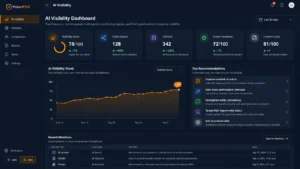
PulseWMS’s AI visibility monitoring workflow is designed around keeping those signals connected to broader website operations.
15. Separate observations from recommendations
For every audit finding, record:
- Observation: what is currently present or missing.
- Why it matters: the user, search, or AI-discovery implication.
- Priority: critical, high, medium, or low.
- Recommended action: the specific improvement.
- Owner: content, SEO, development, or client.
16. Retest after implementation
After improving content, schema, internal links, or technical signals, retest the affected pages. GEO should be managed as an ongoing website-operations process, not a one-time report.
17. Connect GEO findings to client reporting
Clients need to understand what changed and what to do next. Translate technical and content findings into a concise summary with priorities, completed actions, and recommended follow-up.
A connected client reporting workflow helps keep AI-search findings from becoming a separate spreadsheet that nobody revisits.
18. Build the audit into recurring maintenance
Use the GEO audit as a periodic strategic review while lighter AI-search readiness checks run more frequently. The agency website maintenance checklist can cover recurring operational checks, while the GEO audit focuses on deeper visibility, content, entity, and citation-readiness questions.
GEO audit deliverable template
| Audit area | Output |
|---|---|
| Entity clarity | Consistency issues and missing context |
| Answer coverage | Questions answered and content gaps |
| Technical readiness | Crawl, indexability, schema, and page-structure findings |
| Trust and evidence | Unsupported claims and citation-worthy assets |
| AI visibility | Observed mentions, citations, and monitored topics |
| Action plan | Prioritized recommendations, owner, and retest status |
Keep GEO connected to website operations
The strongest GEO process is not a separate content campaign. It is a repeatable operating system that connects technical health, useful content, entity clarity, monitoring, and client communication.
Explore PulseWMS to see how website monitoring, AI visibility, technical review, and client reporting can be organized in one workspace.